Request a quote
Thanks for getting in touch
Part L 2026 Future Homes Standard – A simplified Guide
The 2026 update to Approved Document L Volume 1 marks the next step toward Net Zero, with all New build houses to be net zero ready. Meaning that homes built from 2027 will not need major upgrades to be able to achieve net zero
What’s actually change and What Hasn’t Changed
The 2026 update to Approved Document L Volume 1 marks the next step toward Net Zero, with all New build houses to be net zero ready. Meaning that homes built from 2027 will not need major upgrades to be able to achieve net zero
While the direction is clear lower carbon, more electrification, and greater accountability the fundamentals of compliance will still feel familiar to the current Part L 2021.
Key dates and timeline for Part L 2026
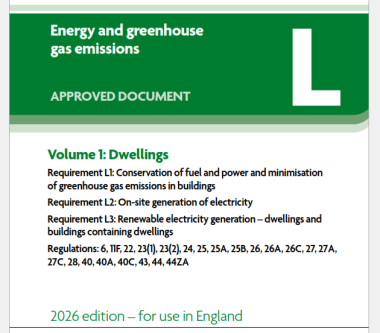
Part L 2026 (FHS) – Released 24th March 2026
Part L 2026 (FHS) – Effective from 24th March 2027
Transitional period 1 year
In effect we will start to see new homes built to Part L 2025 from Late 2027 / Early 2028
Here’s a clear breakdown of what’s changed, and just as importantly, what hasn’t.
What’s Changed in Part L 2026
One of the most noticeable changes is the move away from fossil fuels, changes to the gas CO2 factor and Primary Energy factor, have essentially made it not possible to gain Part L compliance with a new home using fossil fuels. This has changed from Part L 2021 where gas heating is still possible with extensive use of Solar PV.
Stronger Focus on Carbon and Net Zero
The most significant shift is the explicit move from simply reducing enegry usage to the use of more low carbon systems such as heat pumps and Solar PV for space heating and hot water
Solar PV
Solar PV panels must ne integrated, this is no longer an option to gain final compliance, it is a requirement. Houses will require 40% of the ground floor area in PV panels, with flats requiring a lesser amount based on floor area 40% / 4.5
Updates to the Notional Dwelling
The notional dwelling calculation is how SAP compares if the proposed dwelling meet the compliance criteria, so the notional dwelling requirements is a good place to start the Part L design to ensure compliance, rather than the Limiting building fabric values. So, what has changed for the notional dwelling.
Key Notional dwelling changes are
- Air tightness test result – reduced to 4.0 m3/(h.m2)@50Pa, down from 5.0 m3/(h.m2)@50Pa
- Inclusion of decentralised Mechanical Extract Ventilation, changed from natural ventilation with local extracts
- Watse Water heat recovery (WWHR) – added for firth time with an efficiency of 50%
- Solar PV – already mentioned
What Hasn’t Changed
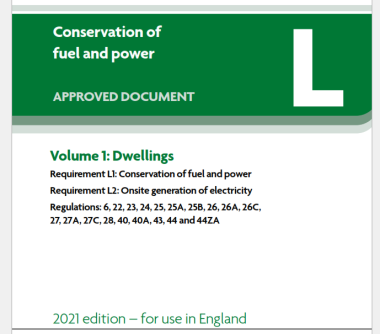
Despite the updates, the core compliance framework remains consistent SAP is still to be used for core Part L energy calculations, though this will be updated to SAP 10.3. After all the talk about the new Home Energy Model (HEM), this has been delayed / put on hold for an unknow amount of time.
Thermal Properties of the notional, despite indication during the consultation, improvement to thermal properties have not been brought forward, Therefore the key thermal properties of the notional dwelling remain the same
External Walls u-value – 0.18 W/(m2K)
Roof (flat/pitched) u-value – 0.11 W/(m2K)
Floor (ground/exposed) u-value – 0.13 W/(m2K)
Window u-value – 1.2 W/(m2K)
Rooflight u-value – 1.70 W/(m2K)
External Door u-value – 1.0 W/(m2K)
Final Thought
If Part L 2021 was about tightening performance…
Part L 2026 is about proving it works in the real world.
Need support navigating Part L 2026?
At Energy Report, we integrate SAP, overheating, and building services strategy from day one helping you design compliant, buildable, and future-proof schemes.
Need Help with Your Project?
We always welcome new projects so if you need a dedicated consultant, we are here to help. Contact us today to build a better future.
Get in touch