Request a quote
Thanks for getting in touch
As the UK pushes towards net-zero by 2050, retrofitting the existing non-domestic building stock has become a critical priority
What is PAS 2038?
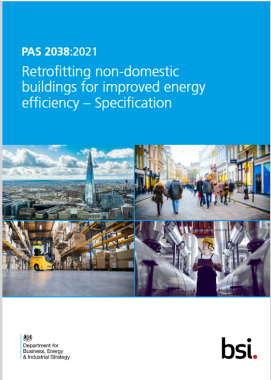
PAS 2038 is the British Standard specification for retrofitting non-domestic buildings for improved energy efficiency. Introduced by the British Standards Institution (BSI) in 2021, it establishes a structured, whole-building approach to upgrading existing commercial and public sector properties.
Unlike traditional compliance-led approaches that focus on isolated upgrades, PAS 2038 treats the building as an interconnected system. It mandates a comprehensive evaluation of the building’s current condition, occupancy patterns, and energy performance before any improvements are specified. The standard applies to all non-domestic buildings over 500m², including offices, schools, hospitals, retail spaces, and industrial facilities. For buildings larger than 1,000m², the standard requires a full calculation of the whole-lifecycle greenhouse gas emissions.
By defining clear professional roles—such as the Retrofit Lead Professional, Lead Assessor, and Lead Designer—PAS 2038 ensures that every stage of the retrofit journey is managed by qualified experts. This framework is rapidly becoming the gold standard for non-domestic retrofit and is increasingly required for accessing government funding and meeting stringent environmental targets.
Why is PAS 2038 Important?
Non-domestic buildings currently account for nearly a quarter of the UK’s total carbon emissions. With an estimated 70% of today’s commercial buildings expected to still be in use by 2050, retrofitting this existing stock is essential for meeting national climate goals.
The implementation of PAS 2038 addresses the historical “performance gap” where predicted energy savings from retrofit measures failed to materialise in practice. By combining accurate energy modelling with real-world operational data, PAS 2038 ensures that design intent translates into actual energy reduction. Furthermore, as Minimum Energy Efficiency Standards (MEES) continue to tighten for the private rented sector, building owners face growing regulatory pressure to improve their assets. PAS 2038 provides a reliable, risk-managed pathway to achieve these required upgrades while protecting the building fabric from unintended consequences such as condensation or poor indoor air quality.
For institutional investors and lenders, compliance with PAS 2038 provides the necessary evidence base to satisfy Environmental, Social, and Governance (ESG) reporting requirements and green finance criteria.
How is the PAS 2038 Process Carried Out?
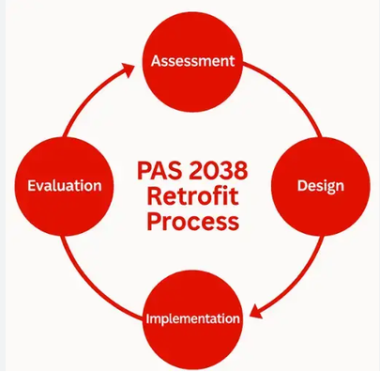
The PAS 2038 framework outlines a comprehensive eight-stage process to guarantee the success of a non-domestic retrofit project. Our team of qualified professionals manages this entire journey on your behalf:
- Project Team Appointment: We establish a qualified team led by a Retrofit Lead Professional to oversee the project from inception to completion.
- Comprehensive Building Assessment: Our Lead Assessors evaluate the building’s context, physical condition, occupancy patterns, and current energy performance, often utilising advanced diagnostics like thermal imaging and air pressure testing.
- Improvement Option Evaluation: We identify and rigorously evaluate potential energy efficiency measures, ensuring they are appropriate for the specific building fabric and use case.
- Improvement Plan Development: We create a tailored, medium-to-long-term improvement plan that sequences the retrofit measures logically to maximise efficiency and minimise disruption.
- Implementation and Installation: We oversee the installation of the specified measures, ensuring all work complies with the rigorous standards set out in the design phase.
- Testing and Commissioning: Post-installation, we conduct thorough testing and commissioning to verify that the new systems and fabric upgrades operate exactly as intended.
- Handover: We provide comprehensive documentation and training to building managers and occupants, ensuring they understand how to operate the upgraded building efficiently.
- Post-Retrofit Evaluation: We conduct ongoing monitoring and fine-tuning to verify that the anticipated energy savings are achieved and the performance gap is closed.
Benefits
- Access to government-backed retrofit funding and grants
- Measurable reduction in operational energy costs and carbon emissions
- Compliance with tightening Minimum Energy Efficiency Standards (MEES)
- Enhanced indoor environmental quality, comfort, and occupant productivity
- Mitigation of risks associated with poorly planned retrofit measures
- Strong evidence base for ESG reporting and green finance requirements
- Preservation of building fabric and extension of asset lifespan
FAQs
What types of buildings require a PAS 2038 assessment?
PAS 2038 applies to all existing non-domestic buildings undergoing energy efficiency retrofits. This includes offices, retail units, schools, hospitals, leisure centres, industrial facilities, and multi-residential buildings such as hotels and student accommodation.
Can smaller commercial buildings use PAS 2035 instead?
Yes, non-domestic buildings that are smaller than 500m² and feature domestic-style building services can opt to follow the PAS 2035 framework instead of PAS 2038. This is provided the building is no more than three storeys high and the assessment is carried out by a qualified Non-Domestic Energy Assessor (NDEA).
Who manages a PAS 2038 retrofit project?
The project is overseen by a Retrofit Lead Professional. This role replaces the Retrofit Coordinator role found in PAS 2035 and carries the responsibility for managing the entire retrofit process from initial planning through to post-completion evaluation, ensuring full compliance with the standard.
Does PAS 2038 apply to historic or listed buildings?
Yes, PAS 2038 covers historic and traditionally constructed buildings. However, these projects require special care to protect the building’s heritage and structural integrity. Professionals working on these buildings must hold specific qualifications, such as a Level 3 Award in Energy Efficiency for Older and Traditional Buildings, and a heritage impact assessment must be conducted.
How does PAS 2038 help close the performance gap?
The standard requires a detailed understanding of how the building is actually used day-to-day, rather than relying solely on theoretical design models. By insisting on rigorous post-installation testing, commissioning, and ongoing evaluation, PAS 2038 ensures that the predicted energy savings are genuinely realised in operation.
Is PAS 2038 compliance legally required?
While not strictly a legal requirement for all private projects, PAS 2038 is increasingly mandated for projects seeking government funding or grants. It is also rapidly becoming the industry-recognised standard required by institutional investors, lenders, and local planning authorities to demonstrate credible decarbonisation efforts.
What energy modelling tools are used during the assessment?
Assessments typically utilise the Simplified Building Energy Model (SBEM) for benchmarking and compliance. For larger or more complex buildings, Dynamic Simulation Modelling (DSM) is employed to accurately predict how energy will be used across different zones, occupancies, and environmental conditions.
How much will a PAS 2038 Assessment cost
The cost of a PAS 2038 assessment varies depending on the size, complexity, and specific requirements of the building. A large industrial facility will require a more extensive
Associated Services
- Non-Domestic EPC
- Part L SBEM
- Energy Statements
- Whole Life Carbon Assessments
- Airtightness Testing
- Thermal Modelling
Need Help with Your Project?
We always welcome new projects so if you need a dedicated consultant, we are here to help. Contact us today to build a better future.
Get in touch