Request a quote
Thanks for getting in touch
As buildings become more energy efficient and the grid decarbonises, the embodied carbon locked into construction materials is now one of the most significant contributors to a building's total carbon footprint
What is a Whole Life Carbon Assessment?
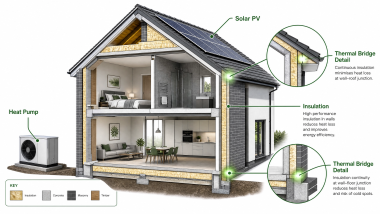
A whole life carbon assessment (WLCA) is a structured evaluation of all greenhouse gas emissions associated with a building across its entire lifecycle. It goes beyond operational carbon — the energy used to heat, cool and power a building — to include embodied carbon: the emissions embedded in the manufacture, transport, installation, maintenance and eventual disposal of building materials.
Assessments are typically carried out in accordance with the RICS Professional Standard: Whole Life Carbon Assessment for the Built Environment and reference the internationally recognised lifecycle stages defined in BS EN 15978. The result is a single, comparable figure expressed in kgCO₂e/m², enabling benchmarking against industry targets and planning requirements.
With local planning authorities increasingly requiring WLCAs as part of planning submissions — and the Future Homes Hub calling for voluntary measurement and disclosure across the new homes sector — early engagement with a qualified assessor is becoming essential for any development of scale.
The Building Lifecycle Stages
A whole life carbon assessment accounts for emissions across all lifecycle stages, as defined in BS EN 15978 and the RICS standard. Understanding which stages are most significant for your project type allows targeted carbon reduction strategies to be developed at the earliest design stage.
| Modules | Stage | Description |
| Modules A1–A3 ★ | Product Stage | Raw material extraction, transport & manufacturing of building products |
| Modules A4–A5 ★ | Construction Stage | Transport to site, installation & construction waste |
| Modules B1–B7 | Use Stage | Operational energy, water use, maintenance & replacement of components |
| Modules C1–C4 | End of Life | Deconstruction, transport, waste processing & disposal |
| Module D | Beyond Boundary | Reuse, recovery & recycling potential beyond the system boundary |
★ Highlighted stages (A1–A5) represent upfront embodied carbon typically the primary focus for new construction projects and planning requirements.
Why Are Whole Life Carbon Assessments Now Essential?
As the UK works towards net zero by 2050, embodied carbon is rapidly moving to the top of the policy agenda. Operational carbon from buildings has been falling steadily as energy efficiency standards tighten, but embodied carbon — which is locked in at the point of construction has remained largely unregulated. That is changing fast.
- Planning policy requirements An increasing number of local planning authorities — including the Greater London Authority, Bristol, and many others — now require WLCAs as part of planning applications for major developments. This trend is accelerating as national policy guidance evolves.
- Future Homes Standard alignment The Future Homes Hub’s Net Zero Transition Plan calls for consistent measurement and voluntary disclosure of whole life carbon from developers at both individual home design and whole development site level. Early adoption demonstrates leadership and prepares your business for mandatory requirements.
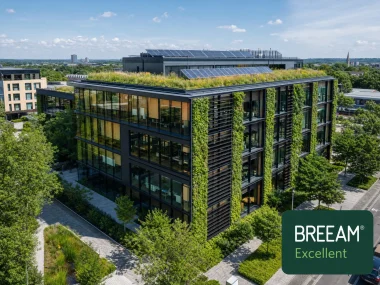
- BREEAM and sustainability certifications Whole life carbon assessments contribute directly to BREEAM credits under the Materials category (Mat 01), supporting higher ratings and the sustainability credentials that increasingly influence planning decisions, investor confidence and occupier demand.
- Investor and lender expectations ESG reporting requirements are driving institutional investors and lenders to scrutinise the carbon performance of their development portfolios. A robust WLCA provides the evidence base needed to satisfy due diligence and green finance criteria.
- Design optimisation and cost savings Identifying high-carbon materials and construction methods early in the design process creates opportunities to substitute lower-carbon alternatives — often with no additional cost and sometimes with direct cost savings through reduced material quantities or simpler construction sequences.
Our Approach to Whole Life Carbon Assessment
Energy Report provides whole life carbon assessments for residential and commercial projects of all scales, from individual dwellings to large mixed-use developments. Our assessments are carried out in accordance with the RICS Whole Life Carbon Assessment Professional Standard and the Future Homes Hub’s WLC Conventions for New Homes, ensuring your results are consistent, comparable and credible.
- Early-stage design review We engage at RIBA Stage 2 or earlier to identify the highest-carbon elements and model alternative structural and material strategies, giving your design team the data to make informed decisions before specifications are locked in.
- Environmental Product Declaration (EPD) sourcing We work with your supply chain to source project-specific EPDs for key materials, replacing conservative default values with accurate, manufacturer-verified data that can significantly improve your assessment results.
- Upfront embodied carbon focus (A1–A5) We prioritise the upfront embodied carbon modules that are most relevant to planning requirements and industry benchmarks, providing a clear, auditable calculation methodology.
- Whole life scope (A–C) Where required by planning conditions or client brief, we extend the assessment to cover the full lifecycle including operational energy (B6), maintenance and replacement (B2–B5), and end-of-life stages (C1–C4).
- Benchmarking and target-setting We compare your results against the LETI Climate Emergency Design Guide targets, the RIBA 2030 Climate Challenge, and the Future Homes Hub benchmarking dataset, providing a clear picture of where your project stands relative to industry expectations.
- Carbon reduction strategy Every assessment is accompanied by a practical carbon reduction strategy, identifying the most impactful design changes and material substitutions available to your project.
Benefits
- Satisfy planning requirements and avoid delays to consent
- Identify and reduce embodied carbon at the most cost-effective stage
- Benchmark your project against industry targets and net zero pathways
- Support BREEAM Mat 01 credits and higher sustainability ratings
- Demonstrate ESG credentials to investors, lenders and occupiers
- Future-proof your project against tightening regulatory requirements
- Expert guidance from initial design through to planning submission
FAQs
What is the difference between embodied carbon and whole life carbon?
Embodied carbon refers to the greenhouse gas emissions associated with the materials and construction processes throughout the lifecycle of a building excluding operational energy use. This includes emissions from raw material extraction, manufacturing, transport, construction, maintenance, replacement, and end-of-life disposal.
Whole life carbon is a broader term that encompasses both embodied carbon and operational carbon (the energy used to run the building over its lifetime, including heating, cooling, lighting and hot water). A whole life carbon assessment therefore provides the most complete picture of a building’s total carbon impact.
When in the design process should a WLCA be carried out?
The earlier a whole life carbon assessment is carried out, the greater the opportunity to influence design decisions and reduce carbon. We recommend engaging at RIBA Stage 2 (Concept Design) at the latest, so that structural system choices, material specifications and building form can still be adjusted in response to the findings.
A preliminary assessment at Stage 1 (Preparation and Briefing) can be particularly valuable for establishing a carbon budget and setting targets that inform the design brief. Assessments can also be carried out at later stages to satisfy planning conditions or to provide a baseline for future projects.
Do I need a WLCA for planning permission?
Requirements vary by local planning authority (LPA). A growing number of LPAs particularly in London and other major urban areas now require whole life carbon assessments as part of planning applications for major developments (typically 10 or more dwellings, or commercial developments above a certain floor area threshold).
We recommend checking the specific requirements of your LPA at the earliest opportunity. Even where a WLCA is not formally required, submitting one voluntarily can strengthen a planning application by demonstrating a commitment to sustainability and alignment with national net zero targets.
What information do you need to carry out a WLCA?
The level of information required depends on the stage of the assessment. For an early-stage indicative assessment, we typically need: architectural drawings (floor plans, sections, elevations); structural system description (e.g. timber frame, masonry, concrete); gross internal floor area (GIA) and number of units or storeys; and an indicative specification for key elements (substructure, superstructure, envelope, finishes).
For a more detailed assessment at later design stages, we will also need a full specification, structural drawings, and where available, manufacturer EPDs for key materials. We are happy to advise on exactly what is needed for your specific project at the outset.
What tools and standards do you use for WLCA?
Our assessments are carried out in accordance with the RICS Professional Standard: Whole Life Carbon Assessment for the Built Environment (2nd edition) and reference BS EN 15978 for the lifecycle stage framework. For new homes, we also apply the Future Homes Hub WLC Conventions for New Homes, which provide a consistent methodology for the residential sector aligned with emerging government policy.
We use industry-recognised carbon assessment tools and reference the latest available Environmental Product Declarations (EPDs) and the Inventory of Carbon and Energy (ICE) database for material carbon factors. Results are benchmarked against the LETI Climate Emergency Design Guide and RIBA 2030 Climate Challenge targets.
How does a WLCA relate to BREEAM certification?
Whole life carbon assessments contribute directly to BREEAM credits under the Mat 01 (Life Cycle Impacts) credit, which rewards projects that carry out a lifecycle assessment of the building’s environmental impacts. Achieving Mat 01 credits can be a significant contributor to reaching higher BREEAM ratings such as Excellent or Outstanding.
If your project is pursuing BREEAM certification, we can coordinate the WLCA with the broader BREEAM assessment process to ensure the methodology and reporting format meets the assessor’s requirements and maximises the available credits.
How much does a whole life carbon assessment cost?
The cost of a whole life carbon assessment depends on the size and complexity of the project, the stage at which the assessment is required, and the scope of lifecycle stages to be covered. A straightforward assessment for a small residential scheme will typically be significantly less expensive than a detailed assessment for a large mixed-use development.
We provide fixed-fee quotations based on the specific requirements of each project. Please get in touch with details of your project and we will provide a competitive, transparent quote with no hidden costs.
How can Energy Report help reduce my project's embodied carbon?
Beyond producing the assessment itself, our team provides practical, actionable guidance on reducing embodied carbon within the constraints of your project. This typically includes: identifying the highest-carbon elements and prioritising reduction efforts; recommending lower-carbon structural and material alternatives with comparable performance; advising on EPD selection and supply chain engagement to improve data quality; modelling the carbon impact of design changes to quantify the benefit of each intervention; and supporting the development of a project-level carbon reduction roadmap aligned with net zero targets.
Our goal is not just to produce a compliant report, but to help you genuinely reduce your project’s carbon footprint in a way that is practical and cost-effective.
Need Help with Your Project?
We always welcome new projects so if you need a dedicated consultant, we are here to help. Contact us today to build a better future.
Get in touch