Request a quote
Thanks for getting in touch
Part L Photographic Evidence: A Guide to BREL Report Compliance for UK Developers
Whether you are developing a new residential estate in Basingstoke, building a single detached home in Surrey, or constructing a block of flats in Birmingham, the days of relying solely on trust for energy performance sign-off are over. The introduction of the Building Regulations England Part L (BREL) report has fundamentally shifted the compliance landscape, making mandatory photographic evidence a critical hurdle for developers and site managers.

This guide explores the strict photographic evidence requirements introduced by the Part L 2021 update and touches on the consequences of failing to capture this information correctly. We outline what must be photographed, why the timing of these photos is critical, and how Energy Report can streamline this administrative burden to ensure your projects achieve Part L compliance and building control completion in a timely manner.
Understanding the BREL Report Requirement
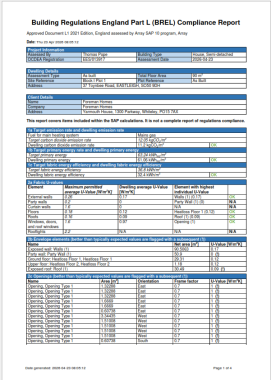
The BREL report is a mandatory two-stage document currently generated by SAP (Standard Assessment Procedure) software. The design-stage report lists the exact specifications required to meet Part L targets.
The As-built report details exactly how the building was built incorporating any changes in specification that have occurred during the build, crucially the As-built Report must be signed by both the developer and the SAP assessor to confirm how the building was constructed.
The core purpose of this requirement is to close the industry-wide “Performance Gap” the difference between a building’s designed energy efficiency and its actual built performance. To bridge this gap, SAP assessors are now legally prohibited from signing the as-built BREL report without reviewing a comprehensive portfolio of high-quality photographs proving that the specified materials and systems were installed correctly.
What Must Be Photographed?
Appendix B of Approved Document L Volume 1 dictates a strict list of critical construction stages that must be photographed. These photos serve as tangible proof of compliance. Site teams must capture evidence across the following key areas:
| Construction Stage | Required Photographic Evidence |
| Foundations and Substructure | Insulation at the ground floor perimeter edge and below the damp-proof course. |
| External Walls | Thermal continuity at ground floor-to-wall junctions, structural penetrations, and wall ties. |
| Roofs | Insulation installation at joist/rafter level, eaves, and gable edges. |
| Openings | Window and door positioning in relation to cavity closers and insulation lines. |
| Airtightness | Specific details demonstrating the implementation of airtightness measures. |
| Building Services Renewables | Identification labels on boilers or heat pumps, primary pipework insulation, and mechanical ventilation ductwork. Identification of any on site renewables and associated controls that contribute to the Part L compliance
|
A frequent mistake is focusing solely on the fabric of the building such as walls and roofs while completely forgetting to photograph the mechanical and electrical installations. Without clear photos of the heat pump model number or the hot water cylinder insulation, the SAP assessor cannot verify the systems, leading to an automatic failure.
The Importance of Timing: Do Not Miss the Window
The most common reason for a BREL report problem is simply missing the opportunity to take the photograph. Construction moves at a rapid pace. Once the dryliners have boarded over the external walls, or the screed is poured over the floor insulation, the evidence is covered over and obtaining that info is not very tricky.
If a site manager fails to photograph the cavity insulation or the thermal bridging junctions before they are concealed, the SAP assessor cannot accept “similar” photos from the plot next door. No photo means no compliance. The severe downside of missing these critical windows is a halted sign-off process. This inevitably leads to delays in securing the building control completion certificate and the EPC, precisely at the high-pressure moment when developers need to hand over the property.
Technical Requirements: Quality, Geolocation, and Traceability
Even when photos are taken at the correct time, they may need retaking if they do not meet technical criteria or identify the correct details. Assessors must be able to perform a qualitative audit of the workmanship, such as ensuring insulation boards are tightly butted together without gaps.
To be accepted, every photograph must adhere to the following standards:
- Geolocation and Timestamps: Photos must have GPS coordinates, date, and time data embedded in the file metadata. This proves unequivocally that the photo belongs to the specific plot being assessed. If location services are turned off on the device, the photo can be considered invalid.
- High Resolution and Clarity: Images must be well-lit, close-up, and clear enough to explicitly show thermal continuity and the specific products being used. Blurry photos taken from a distance are unacceptable.
- Plot-Specific File Naming: Handing over a folder of randomly named files (e.g., “IMG_1234.jpg”) creates an administrative nightmare. Each image file name should include the specific plot number and a detailed reference corresponding to the exact BREL requirement (e.g., “Plot1_Wall_Insulation_P1-3b.jpg”).
Streamlining Compliance with Energy Report
Managing thousands of photographs across a large development is a significant logistical challenge. It requires a cultural shift on-site, where capturing evidence is treated with the same importance as pouring concrete. Using a dedicated photo evidence app can drastically reduce this administrative burden by automatically embedding geolocation data and enforcing standardised file naming conventions.
At Energy Report, we understand the pressure the BREL report places on site teams. We are always on hand to offer proactive guidance on exactly what needs to be photographed and when. The best course of action is to forward your photos to our team as soon as they are taken. By reviewing the evidence progressively throughout the build, we can identify missing elements or poor-quality images before the walls are closed up, preventing the panic of missing photos at handover.
Do not let missing photographs delay your completions. Contact Energy Report today to establish a streamlined, stress-free process for your Part L 2021 BREL compliance.
Need Help with Your Project?
We always welcome new projects so if you need a dedicated consultant, we are here to help. Contact us today to build a better future.
Get in touch