Request a quote
Thanks for getting in touch
Is Part F Extractor testing holding up your New Build or Conversion
Under UK Building Regulations Approved Document F, extractor testing is a mandatory compliance requirement for all new-build dwellings and conversions. Failing to plan, install, and test extract systems correctly can lead to failed building control sign-offs, expensive retrofits, and even long-term damp and mould issues.
Modern UK construction prioritises energy efficiency, resulting in ever-increasing air tightness. While excellent for reducing heat loss, this airtightness makes mechanical ventilation critical. Without a properly functioning extract system, stale air, moisture, and indoor pollutants are trapped inside, leading to poor indoor air quality and structural damage. Consequently, building control bodies now place a much greater focus on ensuring that correct, verified ventilation is provided to every wet room in a property.
What are the Required Part F Ventilation Rates?
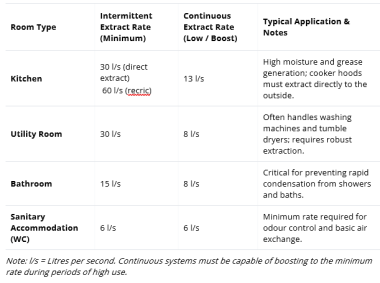
To achieve compliance, mechanical ventilation systems must meet specific performance standards. Approved Document F outlines different minimum extract ventilation rates depending on the room type and whether the system operates intermittently or continuously.
The table below summarises the minimum extract rates required under the current building regulations:
Common Ductwork Pitfalls That Kill Extractor Performance
Many developers and installers purchase high-specification extractor fans only to find they fail flow-rate testing during the final inspection. In almost every case, the culprit is poorly designed or badly installed ductwork.
When planning your ventilation layouts, pay close attention to these five critical ductwork factors:
- Ductwork Length and Resistance: The longer the run of ductwork, the greater the resistance (static pressure) the fan must overcome. Long, winding runs will significantly impede extraction rates
- The Danger of Flexible Ducting: Flexible ducting is cheap and easy to install, but it is highly susceptible to damage. Over time, flexible ducts can sag, accumulate condensation, or completely collapse behind plasterboard, choking off airflow entirely.
- Excessive Bends: Every 90-degree bend in a duct run adds equivalent resistance to several metres of straight pipe. Keep duct runs as straight and direct as possible.
- Inconsistent Duct Diameters: Ensure that the diameter of the ductwork remains consistent with the extractor outlet for the entire length of the run.
The 150mm vs. 100mm Rule: Reducing a duct run from a 150mm diameter to a 100mm diameter can reduce the actual flow rate by as much as 50%. Because of the high extraction rates required for kitchens and utility rooms (30 l/s to 60 l/s), it is highly recommended to use 150mm diameter extractors and matching 150mm rigid ductwork.
The Danger of the "Second Fix" Oversight
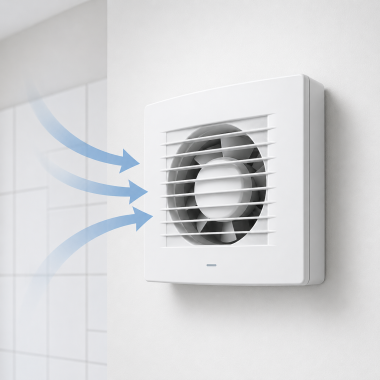
A frequent mistake on-site is treating extractor fans as an afterthought during the second fix installation. Because ventilation is often overlooked until second fix where the chose of extractor is left to the electrical contractor who often purchases on cost, rather than performance.
Discovering a ventilation failure close to building sign-off can cause major delays and severe financial penalties. In the worst-case scenarios, rectifying a failed test requires:
- Replacing existing extractor fans with higher performance models.
- Ripping out finished ceilings to replace collapsed flexible ducting with rigid alternatives.
- Widening duct runs through structural joists to accommodate larger 150mm pipes.
To avoid these costly headaches, ventilation must be detailed during the initial design phase, inspected during second fix, and tested immediately after second fix before final finishes are applied.
From Existing Mould to New Builds: The Impact of Awaab’s Law
The vital importance of domestic ventilation has been thrust into the national spotlight by Awaab’s Law. Introduced to hold landlords legally accountable for resolving damp and mould in existing social housing, this legislation has highlighted a broader systemic issue: poor ventilation directly causes toxic living environments.
While Awaab’s Law focuses on existing properties, its lessons are actively shaping the inspection of new builds and conversions. Building control inspectors are no longer accepting “paper compliance” or self-certification without proof. They demand physical, UKAS-calibrated flow-rate testing to guarantee that the building’s ventilation actually performs as designed. If a new build, airtight home does not have a fully functioning extract system, it will rapidly develop the same hazardous mould problems seen in neglected older stock.
Frequently Asked Questions (FAQ)
Is extractor fan testing mandatory for building conversions?
Yes. Under Approved Document F, mechanical extract ventilation testing is mandatory for both brand-new dwellings and material changes of use (conversions).
Why did my extractor fan fail the flow-rate test?
Manufacturers rate fan performance under zero-resistance conditions. Once installed with ductwork, bends, and external grilles, the resistance reduces the actual airflow. Poor installation, collapsed flexible ducting, or reducing the duct diameter will cause the fan to fall far short of its rated performance.
Can I use flexible ducting for the entire ventilation run?
While permitted, it is highly discouraged for long or concealed runs. If flexible ducting must be used, it should be pulled taut to minimise resistance and securely supported to prevent sagging, kinks, or eventual collapse. Rigid PVC ducting is always the professional choice for reliable compliance
Need Help with Your Project?
We always welcome new projects so if you need a dedicated consultant, we are here to help. Contact us today to build a better future.
Get in touch