Request a quote
Thanks for getting in touch
Commercial EPC & MEES Report for Southampton Warehouse
Energy Report assessed the 1,270.9 m² warehouse at Unit 6 Majestic Road, Nursling, Southampton at EPC E102. Its EPC Improvement Report modelled a full-scope route to A18 and an 82.16% reduction in CO₂ emissions, subject to all assessed measures being implemented and a new EPC assessment.
Project at a glance
| Project location | Unit 6 Majestic Road, Nursling Industrial Estate, Southampton SO16 0YT, Hampshire |
| Building type | Single-storey warehouse with office and WC amenity areas |
| Floor area | 1,270.9 m² |
| Survey date | 23 April 2026 |
| Current EPC rating | E102 |
| Modelled full-scope potential | A18, if all assessed cumulative measures are implemented |
| Modelled annual CO₂ emissions | 10,090 kgCO₂/year baseline; 1,800 kgCO₂/year potential |
| Modelling route | DesignBuilder using the SBEM energy-modelling engine |
The challenge
Unit 6 Majestic Road sits in Nursling Industrial Estate, just north-west of Southampton. The single-storey commercial asset combines warehouse space with office and WC amenity areas a familiar mix, but one that needs its fabric, fixed services and activity zones understood together.
The first step was to establish a dependable non-domestic EPC position. The assessment produced an E102 asset rating. From there, the aim was to turn a single certificate into a more useful route for future decision-making: which improvements could influence the EPC, how they could work cumulatively, and what the full modelled outcome could look like.
For relevant non-domestic private rented property, EPC E is the current minimum standard. A building’s lease position and any exemption must still be assessed separately. This improvement report was therefore not presented as a substitute for legal, technical or financial due diligence. It was an evidence-led starting point for MEES planning and asset improvement.
Our approach
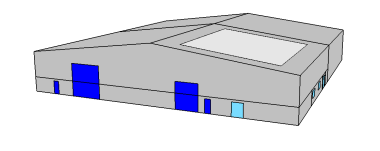
Energy Report surveyed the building in April 2026 and created the EPC baseline from the evidence gathered on site and the available project information. The model was developed in DesignBuilder using the SBEM energy-modelling engine. We then assessed a series of upgrades both individually and as a cumulative package.
The approach covered lighting controls, heating, thermal-envelope upgrades and rooftop solar PV. This made it possible to show not only the effect of particular changes, but also the order in which the modelled pathway builds from the E102 baseline towards a potential A18.
Recommended EPC improvement pathway
The table below follows the report’s cumulative sequence. Each modelled step builds on the measures before it. Lower EPC scores are better.
| Step | Assessed cumulative measure | Modelled EPC | Modelled annual CO₂ |
| 01 | Upgrade warehouse lighting to LED with DALI controls and PIR. | D100 | 9,980 kgCO₂/year |
| 02 | Upgrade office lighting to LED with DALI controls and PIR. | D99 | 9,710 kgCO₂/year |
| 03 | Upgrade WC lighting to LED with PIR controls. | D98 | 9,590 kgCO₂/year |
| 04 | Add electric panel heaters to the WCs. | D92 | 9,100 kgCO₂/year |
| 05 | Replace the roof with an improved construction. | D92 | 9,100 kgCO₂/year |
| 06 | Replace gas boilers serving the offices with a VRF system. | B50 | 4,940 kgCO₂/year |
| 07 | Install new windows and doors at 1.6 U-value. | B50 | 4,910 kgCO₂/year |
| 08 | Add solar photovoltaic panels to the roof. | A18 | 1,800 kgCO₂/year |
The A18 scenario assumes all measures in this cumulative sequence are implemented as assessed in the report.
The outcome
When every assessed measure is combined, the report models a fall in annual CO₂ emissions from 10,090 kgCO₂/year to 1,800 kgCO₂/year. That is a reduction of 8,290 kgCO₂/year, equivalent to the report’s stated 82.16% reduction in CO₂ emissions.
The same full-scope model moves the asset from E102 to A18: an 84-point change in the EPC score. In this sequence, the most significant rating change follows the replacement of the office gas boilers with a VRF system. Roof-mounted solar PV then completes the modelled route to A18.
| OUTCOME IN CONTEXT The report gives the client a transparent, modelled roadmap for a staged discussion about EPC performance, MEES readiness and future asset decisions. Final EPC results depend on the completed works, supporting evidence and a new assessment. |
Why it matters
Commercial properties are rarely improved with one isolated change. The practical question is which interventions make sense together, where they affect the EPC model, and what evidence will be needed when the asset is reassessed.
This Southampton case study shows the value of treating a commercial EPC as more than a transaction document. A considered improvement report can give owners, property managers and developers a clearer technical conversation before committing to a scope of works. It provides a route from an existing rating to a tested set of options, without overstating what the final certificate will be.
FAQs
Does an EPC E rating meet commercial MEES requirements?
For relevant non-domestic private rented property, EPC E is the current minimum rating. A building’s lease position and any exemption must still be reviewed separately. Unit 6’s surveyed baseline was E102.
Is an EPC A18 rating guaranteed after the recommended works?
No. A18 is the modelled potential outcome in the EPC Improvement Report if all assessed measures are implemented. Final certification depends on the completed works, evidence and a new assessment.
Can commercial EPC improvements be planned in phases?
Yes. The report shows a cumulative sequence, but an implementation plan should also consider feasibility, specification, cost, ownership and operational requirements before work starts.
Does Energy Report provide commercial EPC assessments in Southampton?
Yes. Energy Report supports commercial EPC and MEES planning projects across Southampton, Hampshire and the South of England.
Need Help with Your Project?
We always welcome new projects so if you need a dedicated consultant, we are here to help. Contact us today to build a better future.
Get in touch