Request a quote
Thanks for getting in touch
Solar G-Value Explained: Glazing, Overheating and Part L
G-value measures the proportion of solar energy that passes through glazing as heat. Lower-g glass reduces solar heat gain, but the right specification must also balance daylight, winter heating, appearance and compliance—not simply achieve the lowest number.
For architects, developers and housebuilders G value is now this is a design decision worth resolving before glazing is procured. A product that solves one overheating issue may introduce another performance or specification problem.
What does a g-value of 0.40 mean?
A g-value of 0.40 means 40% of incident solar energy contributes to heat indoors under standard rating conditions. This includes energy transmitted directly and heat released inward after the glass absorbs sunlight. It does not mean 40% visible light or a 60% reduction in room temperature. (Guardian Glass)
Three glazing properties must be considered separately:
- G-value: solar heat gain.
- Visible light transmittance (VLT): the proportion of visible light transmitted.
U-value: insulation performance; lower values mean less heat transfer through the specified element.
Why do we model 0.63 and then test 0.40?
At Energy Report, our initial overheating model normally tests the architect’s design at g = 0.63. If the model fails the Part O requirement, our first glazing mitigation test uses g = 0.40 across the building. This helps establish whether reducing solar gains is a workable route before refining the specification.
The 0.63 assumption corresponds to SAP’s generic value for double glazing with a low-E soft coating. It is not a universal double-glazing specification. Where product data is available, the assessment should use the selected glazing’s declared performance, but at design stage or stage 3 RIBA this is often not yet avaiable. (BRE specification)
This modelling sequence is our practical approach – not a regulatory requirement, an automatic pass or a reason to specify identical glass on every elevation.
Will lower-g glass make rooms darker?
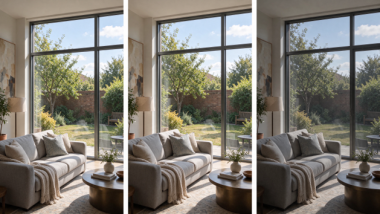
Not necessarily. Solar-control coatings can reduce heat gain while maintaining substantial daylight. For example, Pilkington’s published Suncool 70/35 data show g = 0.37 with 70% light transmittance for a specified 6–16–6 double-glazed unit. These figures apply to that glass build-up, not every unit carrying a similar product name. [Pilkington Glass]
Appearance is also product-specific. Some coatings look neutral; others introduce tint or greater reflectivity. Check physical samples, transmitted colour and internal and external reflectance not g-value alone. If VLT falls, assess daylight separately: room depth, frames and external obstructions also influence the result.
How does g-value affect SAP / HEM and Part L?
Lower g reduces useful winter solar gains, as well as unwanted summer gains, so calculated heating demand can rise. That does not automatically mean poorer Part L compliance. [BRE Specification]
For Future Homes Standard assessments, SAP 10.3’s notional dwelling uses the actual window g-value, rather than a fixed 0.63 reference. Changing the specification therefore affects the benchmark too. As checked in November 2026, SAP 10 is the sole approved Future Homes Standard methodology; with SAP 10.3 due to commence in March 2027 and then the Home Energy Model which has not yet be launched. G value will become more relevant as we pass from SAP 10 to SAP 10.3 then finally HEM.
What should the team agree before ordering glazing?
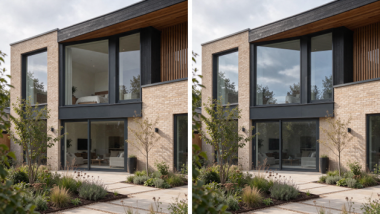
- Coordinate assessments. Review overheating and Part L at the same time, the output of each will affect the other assessment. A SAP pass is not necessarily a Part O pass.
- Compare design options. Our Assessor will test façade-specific glazing, window areas and external shading before assuming a building-wide reduction is necessary.
- Keep inputs consistent. Distinguish glazing-only figures from whole-window values; Part O g-values exclude frames.
- Control substitutions. Recheck alternative products before approval. Similar U-values do not guarantee similar solar control or appearance.
FAQs
Is triple glazing automatically better for solar control?
Use if triple glazing can assist with Overheating, as in general triple glazing has a lower default G value. Though this is not always the case in our experience triple glazing can be advantageous for Overheating as well as offering some advantages for the Part L compliance.
Can solar-control film be a retrofit solution?
Potentially, but confirm compatibility, thermal-stress risk and warranties with the supplier. Though with regard Part O compliance a better solution would be to specify the G value to be manufactured into the glass.
Could changing glass G value affect planning approval?
Generally no this is not considered a major planning issue, though Listed buildings and conservation restrictions may require additional checks. Building Regulations compliance does not override planning requirements.
Resolve glazing performance before procurement
With 17 years of building-energy compliance experience, Energy Report Limited supports project teams across the South of England with practical, coordinated advice.
Before ordering glazing, contact Energy Report to review your overheating, SAP or SBEM strategy and daylight requirements together. We help translate the calculations into clear specifications that protect design intent and reduce late changes.
Need Help with Your Project?
We always welcome new projects so if you need a dedicated consultant, we are here to help. Contact us today to build a better future.
Get in touch