Request a quote
Thanks for getting in touch
Integrated new-home compliance for Darcliffe Homes
Energy Report delivered an integrated compliance package for Darcliffe Homes’ Reading development near Sonning Golf Club, including Part L SAP calculations, a Part O overheating assessment, thermal bridging calculations, Part F extract ventilation testing and airtightness testing.
Assessors - Greg Sewell - OCDEA - Martyn Hughes - Air Tightness Test Engineer - Steph Hughes - Overheating Assessor
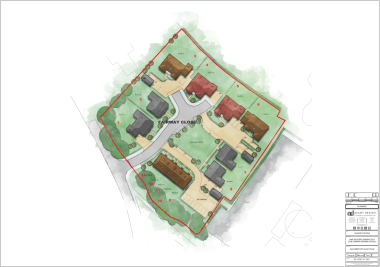
Energy Report was appointed again by Darcliffe Homes to provide a joined-up new-home compliance package for a development of detached and terraced houses on a former golf club car park in Reading, Berkshire. The scope combined Part L SAP calculations, Part O overheating assessment, thermal bridging calculations, Part F extract testing and airtightness testing, creating a clear route from design-stage modelling through to completion-stage evidence.
Project at a glance
| CLIENT | Darcliffe Homes |
| LOCATION | Land adjacent to Sonning Golf Club, Fairway Close, Reading, Berkshire RG4 6J |
| DEVELOPMENT | Detached and terraced houses |
| SITE SETTING | Former golf club car park |
| PLANNING LAYOUT | 14 numbered plots shown on the supplied site layout plan |
| ENERGY REPORT ROLE | Design-stage calculations, overheating assessment and completion-stage testing |
The challenge
A mixed scheme of detached and terraced homes needs more than a set of isolated compliance reports. Different house forms, orientations and junction details can affect energy performance, overheating risk and the evidence needed at completion. On a former golf club car park site in Reading, Darcliffe Homes needed a team that could connect those workstreams from the outset.
The priority was straightforward: give the design and construction teams practical technical input when decisions could still be influenced, then provide the on-site testing that helps turn the design intent into completion-stage evidence. That is why the brief brought SAP, Part O, thermal bridging, Part F and airtightness testing together.
Our approach
Energy Report supported Darcliffe Homes through the full compliance sequence. We started with Part L SAP calculations for the proposed homes, then considered overheating risk under Part O alongside the developing design. Thermal bridging calculations added detail at the junctions where the fabric performance needs to be understood rather than assumed.
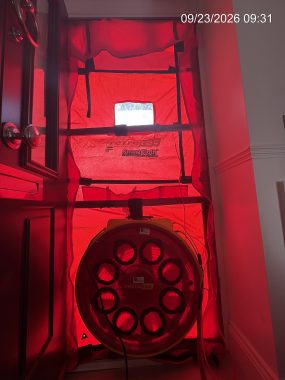
As work progressed on site, the focus moved to the evidence that can only be collected once the homes are built. Part F extract testing and airtightness testing were carried out as part of the wider completion-stage process. The result was a single, consistent technical thread rather than a series of disconnected appointments.
| Service | Energy Report role | Why it matters |
| Part L SAP calculations | Model each home’s energy performance for its Part L compliance route. | Aligns fabric, services and energy targets early. |
| Part O overheating assessment | Assess overheating risk as the design develops. | Helps resolve overheating risk before construction. |
| Thermal bridging calculations | Calculate relevant construction junctions for the energy assessment. | Makes the fabric assumptions more robust. |
| Part F extract testing | Test installed extract ventilation on site. | Records completion-stage ventilation performance. |
| Airtightness testing | Air test homes at the appropriate programme stage. | Records envelope air leakage against the project target. |
Project-specific construction details, test results and final compliance outputs should remain within the formal project records and Building Control submission route.
The outcome
For Darcliffe Homes, the value was a coordinated compliance package tailored to the route from design information to completed homes. SAP calculations, Part O assessment and thermal bridging calculations helped keep the design-stage work connected. Part F extract testing and airtightness testing then provided the relevant site-stage evidence as the build progressed.
This approach gives the project team clearer handovers, fewer separate technical touchpoints and a consistent understanding of what needs to be evidenced at each stage. It is especially useful on a development with more than one house type, where repeating the right process is as important as getting the individual details right.
| OUTCOME IN CONTEXT Energy Report provided Darcliffe Homes with one approachable technical partner across Part L, Part O, thermal bridging and completion-stage testing — supporting a more connected route through residential compliance. |
Why it matters
Residential compliance is most effective when it is considered before the build is fixed, not rescued at the end. Early energy and overheating work can inform decisions while the design team still has options. Later, airtightness and extract-ventilation testing help ensure the completed home is assessed with real site evidence, not assumption.
For housebuilders in Reading, Berkshire and across the South of England, that joined-up support can make the compliance journey more manageable. The Darcliffe Homes project shows how a repeat-client relationship can bring the right technical services together around the construction programme and the homes being delivered.
FAQs
What work did Energy Report undertake for Darcliffe Homes in Reading?
Energy Report provided Part L SAP calculations, a Part O overheating assessment, thermal bridging calculations, Part F extract ventilation testing and airtightness testing for the new homes at land adjacent to Sonning Golf Club in Reading.
Can Part O overheating assessment be considered alongside SAP calculations?
Yes. Considering the Part L energy assessment and Part O overheating assessment together gives the design team a better view of how fabric, glazing, ventilation and house form can interact as the design develops.
When should thermal bridging calculations be completed?
Thermal bridging should be addressed early enough for the construction details to be coordinated before they are built. The results can then inform the fabric assumptions used in the energy assessment.
Why are both Part F extract testing and airtightness testing useful
They address different parts of completed-home performance. Part F extract testing records extract ventilation performance, while airtightness testing measures the air leakage of the building envelope against the project target
Does Energy Report support housebuilders in Reading and Berkshire?
Yes. Energy Report supports developers and housebuilders with practical new-home compliance services across Reading, Berkshire and the South of England.
Services provided
Need Help with Your Project?
We always welcome new projects so if you need a dedicated consultant, we are here to help. Contact us today to build a better future.
Get in touch